



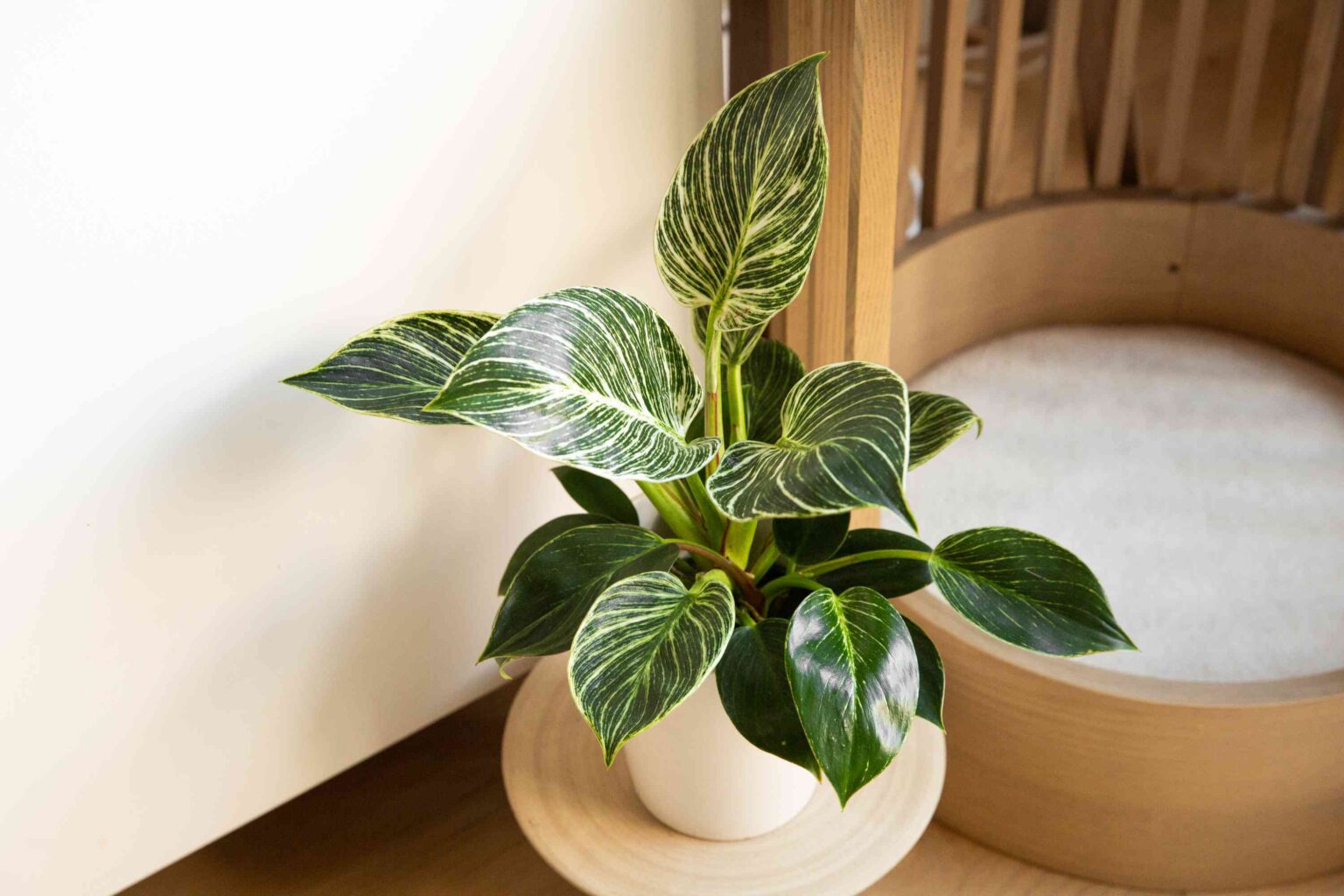
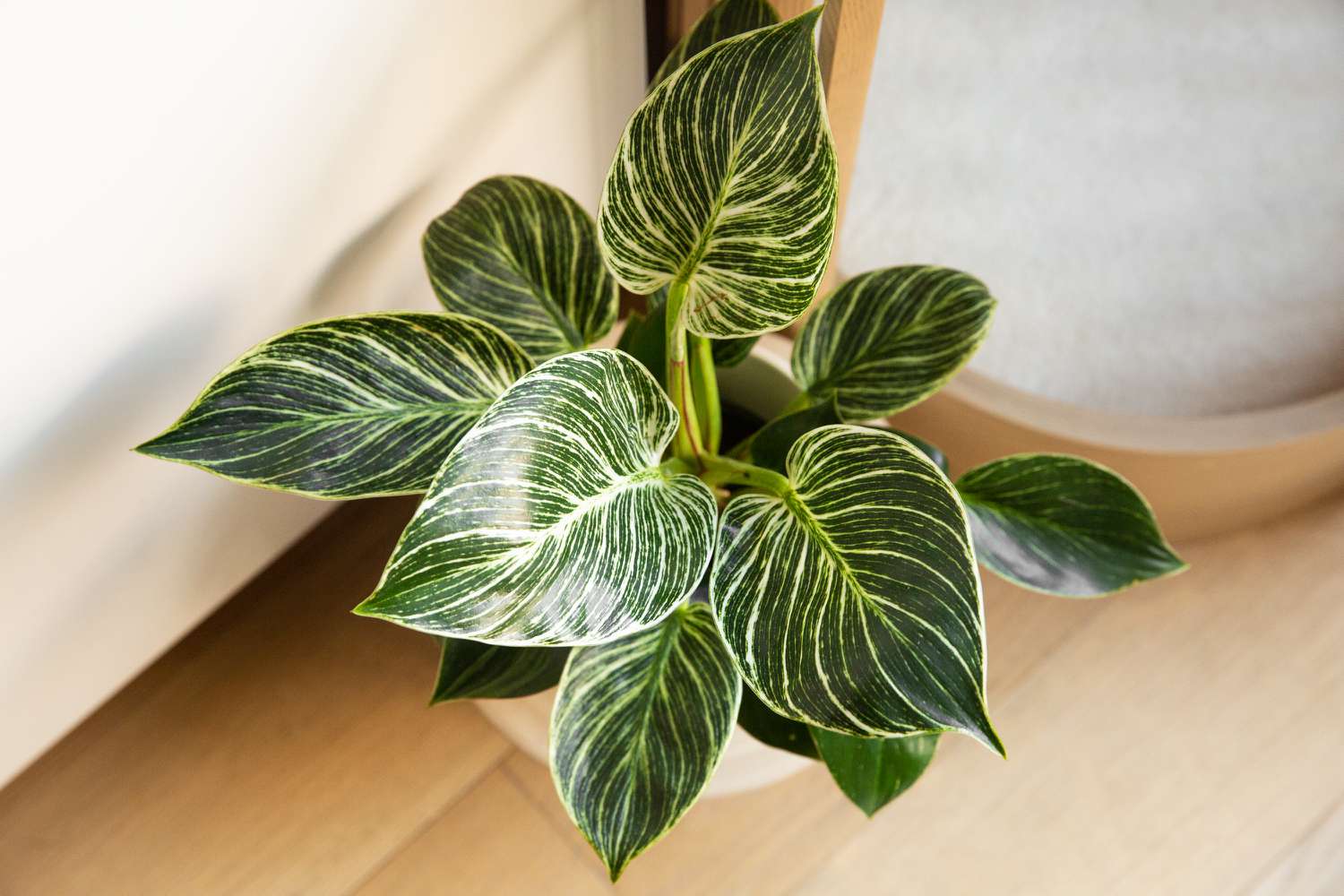
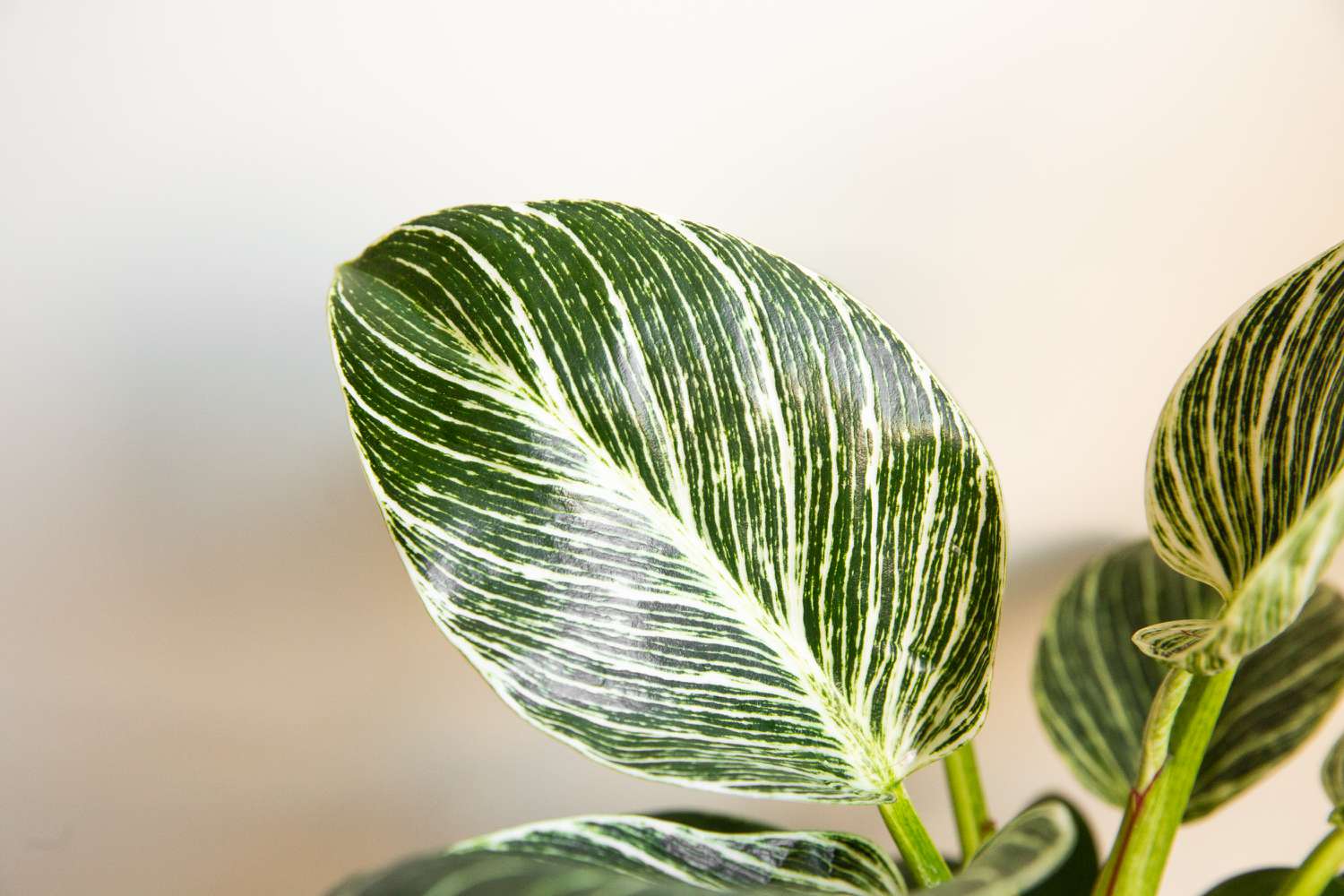
Philodendron birkin is a sought-after cultivar of Philodendron believed to be either a rare mutation of Philodendron ‘Rojo Congo’ or a hybrid of two cultivars, ‘Congo’ and ‘Imperial Green’. It stands out because of the unique creamy white or yellow streaks on the green leaves.
It has a thick, upright, self-supporting stem, promoting a more tree-like appearance. Slow-growing and compact, it’s a great plant for small spaces. Note that the variegation only appears on mature plants. Sometimes the plant produces leaves with a reddish tone or part red, part white stripes.
Like other philodendrons, philodendron birkin is toxic to people and pets.
| Common Name | Philodendron birkin, white wave, birkin white wave |
| Botanical Name | Philodendron ‘Birkin‘ |
| Family | Araceae |
| Plant Type | Perennial |
| Mature Size | 3 ft. tall, 3 ft. wide |
| Sun Exposure | Partial |
| Soil Type | Well-drained |
| Soil pH | Acidic, neutral |
| Hardiness Zones | 9-11 (USDA) |
| Native Area | Central America |
| Toxicity | Toxic to people, pets |
Philodendron Birkin Care
Here are the main care requirements for growing a philodendron birkin:
- Place it in a location with bright, indirect light.
- Use a potting mix for aroids or make your own.
- Water only when the top layer of soil has dried out.
- Keep the room temperatures between 65°F and 85°F.
- Fertilize every two months during the spring and summer.
jardineria Profesional / Phoebe Cheong
jardineria Profesional / Phoebe Cheong
Light
Philodendron birkin needs filtered light. A west- or east-facing window with medium bright, indirect light usually works well. If the plant doesn’t receive enough light, it will produce less variegation.
Soil
Philodendron birkin thrives in potting mixes specially designed for tropical plants, though a general houseplant mix should work fine. To make your own, blend one part potting soil, one part orchid bark, and one part perlite, which provides the right amount of acidity, moisture retention, drainage, and aeration.
Water
Philodendron birkin should be watered when the top inch or two of soil is dry. They are hard-to-kill plants but not impervious to overwatering. Soggy soil frequently leads to mushy stems and root rot. Let the soil mostly dry out before watering again. Use a moisture meter if you aren’t sure.
While you don’t want the plant to completely dry out, don’t panic if you forget to water it occasionally. They’re pretty forgiving and usually perk up after a thorough watering.
Temperature and Humidity
Philodendron birkin thrives in warmth and humidity, with ideal temperatures ranging from 65°F to 85°F, and never dropping below 55°F.
The humidity level should be between 50% and 60%, though if it’s lower than that it’s very likely the plant will be fine. If the air in your home is dry (below 30%), use a humidifier or place a pebble tray filled with water underneath your plant. They are great houseplants for bathrooms.
Fertilizer
Regular fertilization isn’t always essential for philodendron birkin, and too much feeding causes root burn and yellowing leaves. However, feeding with a balanced, weak solution of houseplant fertilizer every couple of months during the growing season in the spring and summer promotes faster growth, improved variegation, and glossy foliage.
What Does a Mature Philodendron Birkin Look Like?
A mature philodendron birkin has likely grown taller (up to 3 feet tall) with leaves branching off the main stem in alternating directions, and less dense growth. Some leaves may even get thick stripes of pink variegation.
This can be a little confusing at first, because the philodendron birkin you purchased at the store was likely quite compact with mostly dark leaves with white lines.
Pruning
This slow-growing plant doesn’t have any demanding pruning requirements. Just remove any damaged or older leaves so all the energy is directed to the healthy foliage. Use sharp, clean pruners or scissors to do so.
How to Make a Philodendron Birkin Bushier
Philodendron birkins can start to look a little sparse after a few years at home. To make your philodendron look bushier, move it to a spot that gets brighter light. Additionally, you can take a cutting to encourage branching. Propagate a piece of the plant and add it to the original pot for another stem.
Propagating Philodendron Birkin
Philodendron birkin is easily propagated from stem cuttings. Here’s how:
- Take a cutting. Take a 4- to 5-inch stem cutting with four to six leaves using a clean pair of pruners or scissors.
- Remove lower leaves. Remove the bottom leaves to expose the nodes. Leave two or three leaves at the top of the cutting.
- Place cutting in water. Submerge the nodes on the lower half of the cutting in water and place the container in a spot with bright, indirect light.
- Keep water clean. Change the water every few days.
- Repot once roots are several inches long. Once you see small white roots sprouting in the water that are at least one inch in length (but less than three inches in length), the cutting is ready to be moved to soil. Usually, this takes around two to four weeks.
- Pot in soil. Choose a moist, well-draining mix (a houseplant mix should do fine). Plant the cutting and moisten the soil. Put it in the same spot where it was in the water, receiving bright, indirect light.
- Care for as usual. You can care for the plant as usual, but be careful not to let the soil dry out in the first few weeks. It’s important the soil stay moist while the roots are acclimating to their new environment.
Potting and Repotting Philodendron Birkin
This slow-growing philodendron needs repotting only when the roots grow out of the drainage holes. This is also an opportunity to refresh the potting mix.
Don’t be tempted to go too large with the new pot—it’s more likely that excess moisture will gather, often leading to root rot. A couple of inches larger in pot diameter is usually plenty.
Add a fresh batch of aroid potting mix until the pot is around a third full. Once the plant is in, fill in any gaps around it until the mix reaches just below the pot’s rim, after gently patting the soil down. After watering, return the plant to its original spot.
What You’ll Need
- A grow light will increase variegation on leaves.
- A mister will help you clean the leaves of the plant and keep it healthy.
- A humidifier will give the plant the high humidity it needs.
Common Problems With Philodendron Birkin
Philodendron birkin is easygoing but not immune to problems. To keep the foliage looking its best, it still needs the right light, water, and humidity levels. Look out for the following issues, which are often signs that you need to change something.
Leaves Turning Yellow
It’s not unusual to see older leaves at the base of the plant yellow and drop, making way for newer, healthier growth above it. However, if you’re seeing unattractive yellowing leaves on new growth or in large quantities, it’s most likely a sign of overwatering or too much fertilizer.
Brown Tips
When the edges or tips of your plant’s foliage start to turn brown, it’s likely because you need to up your watering schedule or provide higher humidity levels. If you have a lot of tropical plants, consider investing in a humidity meter.
If levels are below 50 percent, use a humidifier or set it on a tray filled with pebbles and water. Keep it away from heating vents and consider a spot like a bathroom with higher humidity levels.
Browning leaves might also signal that your plant is in a spot where it’s receiving too much direct intense sunlight.
Curling Leaves
If the leaves are beginning to curl, it might be an early sign that it isn’t getting enough moisture. If the top few inches of soil are dry, it’s time to water. Too much fertilizer can also cause curling and browning leaves.
Dropping Leaves
These tropical plants like to be kept consistently warm and away from drafts. A sign that your birkin needs a warmer spot is regularly dropping leaves.
Pests to Watch
Philodendron birkin are also susceptible to pests such as spider mites, mealybugs, aphids, and scale insects, all of which can be treated with neem oil.
-
Does philodendron birkin climb?
No, philodendron birkin does not climb. A supportive pole may help the plant grow upright as it becomes more top-heavy.
-
Is philodendron birkin rare?
No, philodendron birkin is not rare. It used to be considered a rare plant because demand was high and supply was low, but it has become more popular over the years and is not widely available for a reasonable price.
-
Why is the variegation fading on my philodendron birkin?
The variegation on a philodendron birkin may fade if there isn’t enough light. Move the plant to a spot that gets bright but indirect light. Due to the unstable nature of this mutation, there is also a possibility that it could revert to a Rojo Congo, with the variegation disappearing permanently.
-
Is philodendron birkin a good houseplant?
Philodendron birkin is a great houseplant. It stays a compact size, it has unique and attractive leaves, and it’s easy to care for. It needs watering less frequently than other philodendrons with thinner leaves, like heartleaf philodendron.
-
Does philodendron birkin purify the air?
It’s difficult to say if philodendron birkin purifies the air. No studies have been done specifically on philodendron birkin’s ability to purify air. The study we have about plants purifying the air involves spider plants, and it requires about 25 spider plants to purify the air in one room.
-
How big do philodendron birkins get?
In perfect conditions, a philodendron birkin can grow to 3 feet tall and spread as wide as 3 feet, though it’s more likely to grow to around 2 feet tall and 2 feet wide.